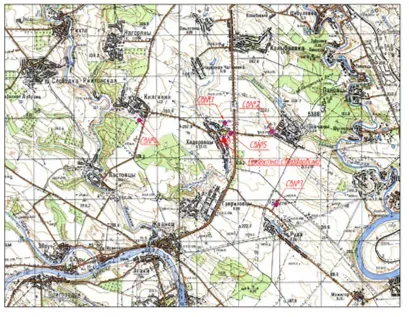
New construction of a water intake well for water supply needs of the Khodorovets Lyceum at the address: village Khodorovtsi, str. Shkilna, 15, Kamianets-Podilsky district, Khmelnytskyi region
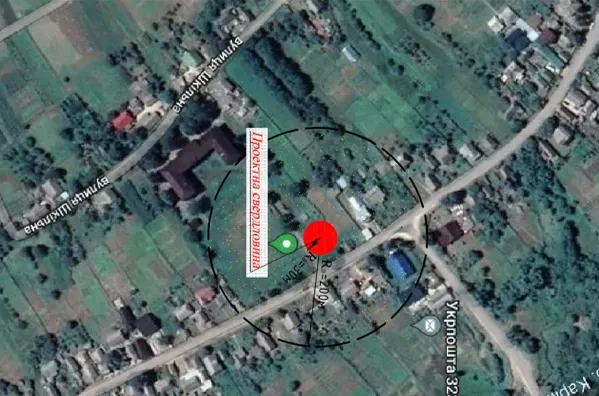
New construction of a water intake well for water supply needs of the Khodorovets Lyceum at the address: village Khodorovtsi, str. Shkilna, 15, Kamianets-Podilsky district, Khmelnytskyi region
Total project budget
4 475 000 UAH
Project goal: The main purpose of the project is to provide water for the needs of the Khodorovets Lyceum, located at: village Khodorovtsi, Shkilna Street, 15, Kamianets-Podilskyi District, Khmelnytskyi Region. Currently, the Lyceum is supplied with water from an existing mine well, which after drilling the well will remain a reserve source of water supply. The project involves the construction of an 80 m deep water intake well to the Silurian aquifer.
The construction site is located within the elevated denudation-accumulative plain of the Volyn-Podilskyi Upland. Quaternary, Neogene and Silurian deposits are involved in the geological structure of the exploration area. Quaternary deposits are represented by loams with sand layers exposed up to 7 m. Neogene deposits are represented by clays with pebbles with sand layers, limestones with clay layers, sand exposed with a total thickness of up to 23 m. Silurian deposits are represented by limestones with mudstone layers. Groundwater lies at a depth of more than 3 m. The well is located on a flat area with a slight slope towards the Dniester. In geomorphological terms, it is located within the Volyn-Podilsky Upland, which is characterized by both a strongly wavy, sometimes convex, or flat surface, and the presence of valleys cut into a depth of more than 40 m. The general slope of the terrain from north to south, absolute elevations range from 200 m to 280 m. Modern physical and geological processes manifest themselves in the form of modern erosion (erosion), karst and landslides. Modern erosion processes sometimes lead to the formation of cliffs above river banks and the formation of ravines on the slopes of river valleys. The well is designed for water-pumping horizons of Silurian deposits, which are selected in accordance with clause 8.5. DSTU 4808:2007. These water pumping horizons are interlayer pressure waters, which are most protected from possible pollution, reliable in terms of water supply stability and mainly meet the hygienic requirements for drinking water intended for human consumption. The waters of the water pumping horizon are transparent, colorless and odorless, pleasant to the taste, slightly mineralized, the dry residue does not exceed 1.0 g/l, mainly 0.5-0.7 g/l. The waters are moderately hard, the total hardness varies from 2.6-11.0 mg.eq.
Good water quality and polyhydricity of this horizon allow it to be used for centralized water supply.
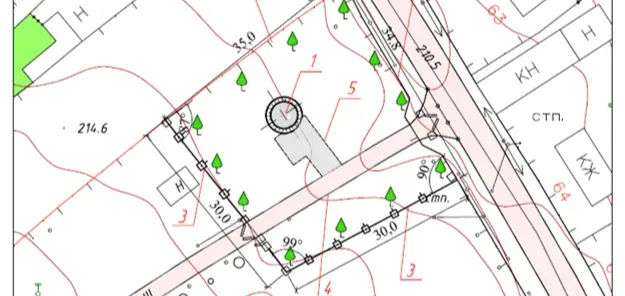
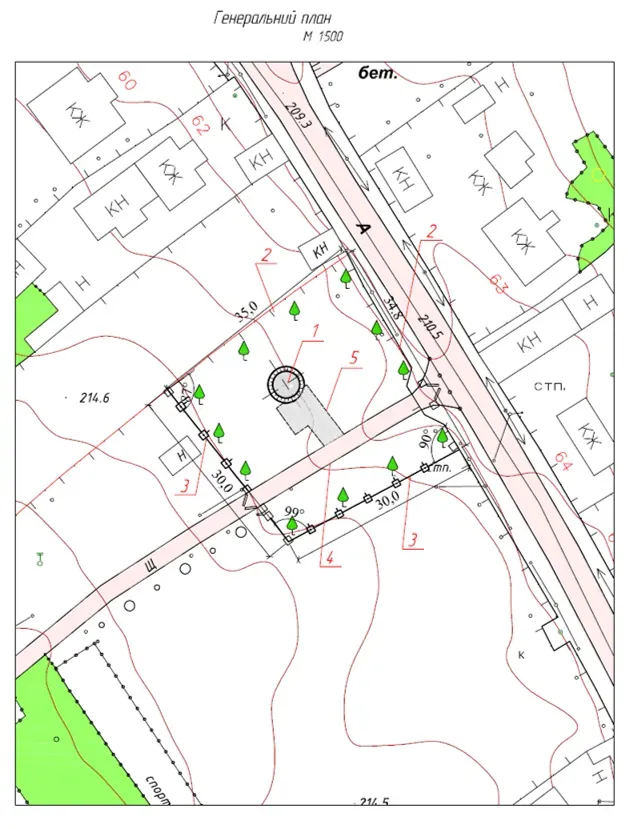
To preserve the drinking quality of water, as well as prevent pollution of the aquifer, in accordance with the current regulations on the procedure for designing and operating sanitary protection zones for water supply sources and water pipelines for domestic and drinking purposes, and Chapter DBN V.2.5-74:2013 "Water supply. External networks and structures", sanitary protection zones (ZSO) are established within the designed water intake, in which special measures are implemented to eliminate the possibility of contamination of the water intake and the aquifer in the area of the
water intake.
The total water requirement for water supply to the needs of the Khodorovets Lyceum at the address: village of Khodorovtsi, ul. Shkilna, 15, Kamianets-Podilskyi district, Khmelnytskyi region is up to 10 m3 / day. To meet this need, a well is designed for the Silurian aquifer:
- well depth – 80 m,
- expected flow rate – up to 4m3/h,
- initial well diameter – 168 mm,
- final diameter – 139.7 mm.
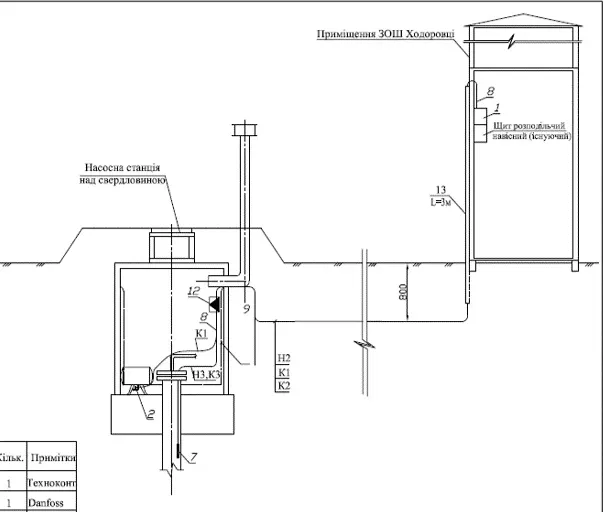
The well is equipped with a Pedrollo 4SR4/12F submersible pump with a 1.1 kW electric motor.
The project provides for annular cementing of a 168 mm diameter casing column from a depth of 31 m to 0 m, which prevents surface water and water from aquifers located above from entering the aquifers that will be operated directly near the well. To prevent depletion of aquifers, it is planned to monitor static and dynamic water levels during well operation.
The main works on this project include the following:
- preparatory work: construction of temporary buildings and structures, arrangement of temporary fencing of the construction site and access road;
- drilling of an artesian well;
- construction of a pumping station;
- installation of water lifting equipment and shut-off valves.